The Kings Bridge Wildlife Conservation Area in Mills River offers a unique opportunity to connect with nature while witnessing the transformation of a natural floodplain restoration.
Kings Bridge is public land managed by the NC Wildlife Resources Commission, on the banks of the French Broad River. Conserving Carolina purchased the 87-acre property in 2020 and transferred it to the Wildlife Resources Commission in 2021. The two partners went on to work together on a natural floodplain restoration that brought back wetlands and a fish habitat slough, completed in 2025. Today, Kings Bridge is open to the public for fishing, birding, and wildlife observation.

What is a Natural Floodplain Restoration?
Kings Bridge is the first natural floodplain restoration in WNC to open to the public. This new public land allows people to witness first-hand how nature is making a comeback in the growing network of places where we are restoring wetlands, sloughs, and natural areas areas beside our waterways.
Along most of the upper French Broad River watershed over the last couple of centuries, people worked to separate land from water. Berms were built to keep the river in a set channel, while ditches were dug to drain water off the land. While this did expand land for agriculture and development, we lost too much of the important natural areas that we need along our waterways.
Now, at a growing chain of natural floodplain restorations in WNC, Conserving Carolina and our partners are bringing back natural corridors along our rivers, while also working to preserve farmland in much of our river valleys. In a restored natural floodplain, the river is invited to spill over into wetlands and low-lying areas. This offers numerous benefits:
- Reduces the risk of both floods and droughts, in a time of increasingly extreme weather.
- Brings back much-needed wildlife habitat, including rich habitat for fish and birds.
- Improves our water quality by preventing erosion and allowing natural systems to filter water.
During Hurricane Helene, just three natural floodplain restorations—including Kings Bridge—stored over 1.25 billion gallons of water! This demonstrates the vital role these projects can play in flood safety.

Where is Kings Bridge Wildlife Conservation Area?
Kings Bridge Wildlife Conservation Area is located on Highway 191 between Hendersonville and Mills River, on the east side of the road. You can find the location in Google Maps. Look for a gravel parking area before a green metal gate.
What Will You Find at Kings Bridge?
Keep in mind that Kings Bridge is a work-in-progress, with construction of the slough and wetlands just completed in late 2024 with vegetation planted in early 2025. Over time, this already vibrant habitat will grow in to become even more lush and full of life!
Parking: Look for a gravel parking area on the east side of the road, before a green, locked gate. When parking, do not block the gate. There are no restrooms.
Paths: There is an access path that you can walk from the parking area to the banks of the French Broad River and the fish habitat slough—approximately 0.4 miles. There are no other established trails at this time. You may walk around the property, but watch your step! Look out for young sapling trees, live stakes, and new vegetation, especially near the mouth of the slough.
Slough: You will see a fish habitat slough, which is like a pond connected to the river, providing calm backwater habitat for fish. A small wooden structure on the edge of the slough houses scientific equipment to track muskie and other fish using the slough.
Wetlands: There are 36 acres of restored wetlands which were created by plugging drainage ditches and by digging low-lying areas for water to pool.
Meadows: Much of the property is a flat, grassy meadow offering exceptional views of the Blue Ridge Mountains, including Mt. Pisgah.
Future Plans: The NC Wildlife Resources Commission has plans to install a boat put-in and create a loop trail around the property.

Fishing at Kings Bridge
Kings Bridge offers vital habitat for fish with the backwater slough, a feature that was once common along the French Broad River. The calm backwater offers a place for fish to escape from the river’s current. Out of the strong current, they have the habitat they need to forage, rest, and spawn. This is especially important as a refuge during floods.
Muskellunge—or muskie, our largest native fish—were detected in the slough just days after tracking equipment was installed. Learn more about muskie restoration in the French Broad.
Fishing is not allowed in the fish habitat slough during March, April, or May, when fish are spawning and fry are emerging. However, fishing along the riverbank is permitted year-round.
Birding at Kings Bridge
Birders see a high diversity of species at Kings Bridge because of the variety of habitat, including the river, wetlands, woods, and meadows. Wading birds, waterfowl, songbirds, and raptors all frequent Kings Bridge, and rare birds have been reported.

Wildlife Observation at Kings Bridge
Kings Bridge offers diverse habitat types, both terrestrial and aquatic. Visitors may see all kinds of wildlife, such monarch butterflies, colorful dragonflies, box turtles, deer, bear, or foxes.
No Hunting
Hunting is not permitted at Kings Bridge due to the proximity of the road and nearby homes. The entire site is a designated Safety Zone.
A Plant Community Inspired by Native Traditions
Historically, the Cherokee cultivated natural communities that offered rich sources of nutrition for both people and wildlife. New plantings bring this tradition back at Kings Bridge with young trees and shrubs that include pawpaw, hazelnut, elderberry, mulberry, persimmon, and black cherry. In addition, plants that provide valuable artisan resources—like rivercane for basket making and yellowroot for dyes—are now growing at Kings Bridge, with plans for future sustainable harvest by the Cherokee.

Thank You to the Partners that Made Kings Bridge Possible!
This restoration project on new public land is made possible by generous funding from U.S. Fish and Wildlife Service, National Fish and Wildlife Foundation, and NC Land and Water Fund.
The Big Picture of Natural Floodplain Restorations
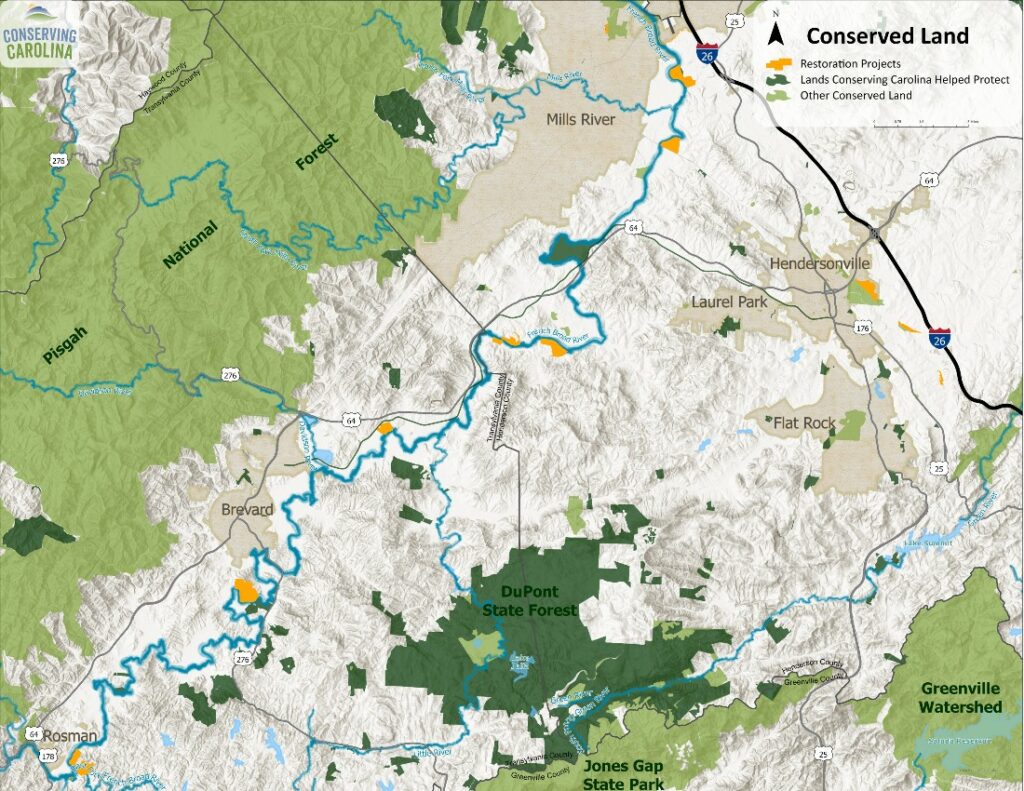
Conserving Carolina has seen great momentum for natural floodplain restoration since we completed the Mouth of Mud Creek restoration in 2020. This map shows natural floodplain restoration projects, either completed or in progress.
Please note that most of these projects are on private property and not open to the public, although the enhanced scenery and wildlife habitat can be enjoyed while floating or paddling the river. We have plans for future public access at the Mouth of Mud Creek and Pleasant Grove.