Rain Gardens
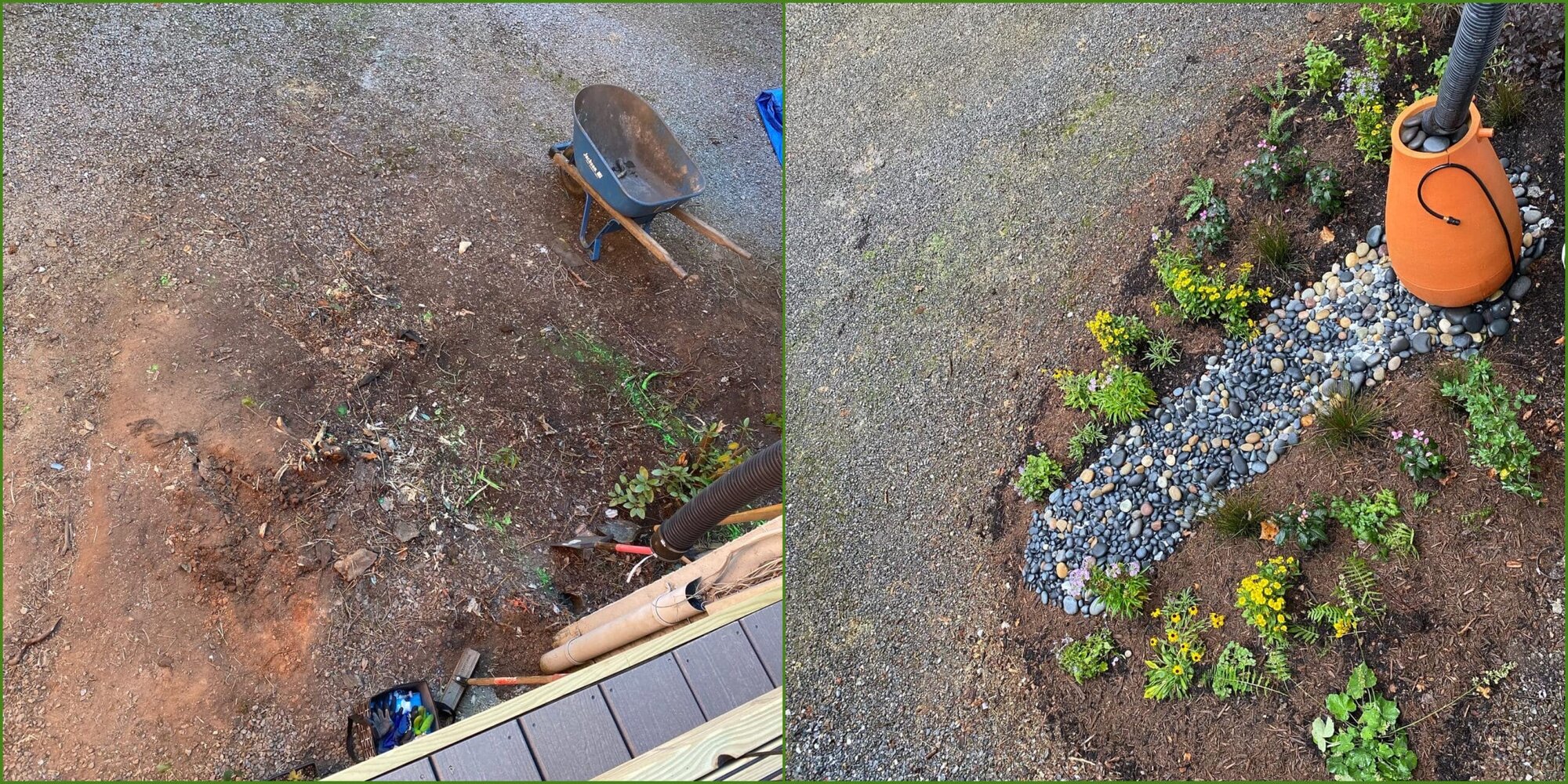
by Brannen Basham of Spriggly’s Beescaping
Whether it’s flowing torrents or stagnant wet spots, chances are every property has some sort of issue with stormwater runoff. This rings especially true if the grading of the plot was changed in some way during clearing and/or construction. It doesn’t take very long for water to cause significant problems if left to run unchecked in these situations. Local clay soils can make things even more difficult, as once saturated they easily compact, making it more difficult for water to percolate and disperse naturally. The resulting above-ground runoff will either leave the area as quickly as possible, taking your hard earned real estate with it, or puddle and pool until it finds a way of least resistance, usually into or underneath a structure or garden bed. While sometimes daunting, most of these problems can be reliably fixed, especially in and around a garden or house.
Lots dug directly into the side or base of mountains or hills are normally not nearly as steep as the surrounding topography, and act as traps for any water runoff passing through. Even if you live in a relatively flat area, it’s a good idea to keep an eye on your surroundings during heavy rainfalls to get an idea of how groundwater moves through or collects. It’s always easier to fix small erosion and/or flooding problems early, before they possibly become a larger issue down the road.
Erosion takes place when stormwater runoff has a chance to get moving at a decent pace. Once a small channel has been etched into the ground, more and more water is funnelled into the area until it is eventually a raging river during heavy rains. When it comes to water, treat your gardens like a luxury retirement village- keep it moving as slowly as possible please, so as not to disturb the peace. To help slow down areas of rapid water movement, first look to reduce the incline of any sharp slopes. Planting the area with a variety of native grasses, wildflowers, and shrubs will work wonders at holding your soil in place, while buffers of river rocks or other stone can act as speed bumps. For standing water, dig a depression and fill it with natural stone large enough to maintain voids between stones (.75-1.5” is preferable) wrapped in drainage fabric. This will help collect and hold the water below the soil surface, where it can more readily percolate into without compacting the upper layers of earth. For especially waterlogged areas, a French drain will move more volume from one place to another. Wrap your French drains in the drainage fabric, burrito-style, being careful not to overlap the fabric as it comes together. When evicting water from your property, it’s important to make sure you aren’t just shooting it downhill for another neighbor or generation to deal with. I always like to end French drains in a small retention basin designed to catch, hold, and most importantly slow water as it exits the problem area and slowly seeps into the soil. Add a final layer of stones on top, not soil or grass, to ensure that water is filtered as it enters from the top.
While collecting and/or moving stormwater runoff belowground is a powerful tool when necessary, the true power and efficiency of rain gardens comes to fruition when surrounded by a diverse collection of native plants. Local riparian plants- or those who naturally find themselves growing on or near stream banks- are perfectly suited to this task. The round stalks and leaves of rushes are most at home in very wet conditions, although once established they can survive in relatively dry locations as well. Triangular-leaves sedges are often lower growing than clumping grasses while also being more shade tolerant, although there are certainly large and sun-loving exceptions. Large grasses thrive in full to part sun, and many can grow in poor soils. These plants are wind-pollinated, but they are still important habitat for bumble bees and other beneficial wildlife while they work their deep roots into the soil.
Rain gardens benefit from dense plantings of tall, medium, and ground-hugging wildflowers and the different types of roots they sport. These are best planted in the ‘middle zone’ of a rain garden, in between the near-aquatic rushes, cat-tails, Jewelweed, and other water’s edge plants. Use wildflowers like Geranium, Iris, Jewelweed, Lobelia, Rose Mallow, and Joe-Pye Weed. Ferns can be used as well, with Cinnamon, Sensitive, and Christmas Ferns among the most resilient riparian options. Shrubs like Ninebark, Silky Dogwood, Sumac, Elderberry, Leucothoe, Spicebush, Buttonbush, Clethra, and Itea are all generally great choices, although there are other natives that will provide similar benefits depending on your location. Try and visit nearby natural wetland spaces to see which trees and shrubs might grow best in your specific area if possible.
Want to learn more about gardening for the planet? Check out this special offer!